Contemporary kitchen design: clean lines, hidden storage and honest materials
A contemporary kitchen is less a fixed style than an attitude: reduce visual noise, let materials speak, hide what does not need to be seen and make every element work hard. The results range from warm, wood-lined rooms to sleek white or dark lacquered spaces, but they share clean lines and an emphasis on function. The catch is that minimalism is unforgiving. A kitchen with nothing on display has to have somewhere for everything to go. This guide covers the defining features and the practical decisions that make a contemporary kitchen work.
Defining features
Flat-panel cabinetry
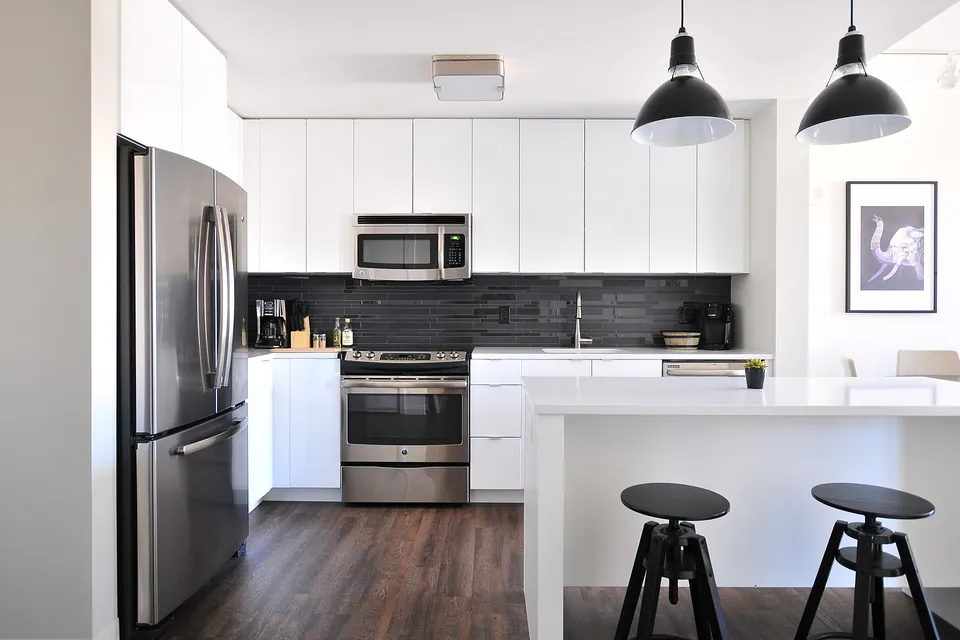
Slab doors and drawer fronts without frames or mouldings are the signature of the style. They are usually built on frameless (European-style) cabinet boxes, which give slightly more interior space and allow narrow, even gaps between fronts. Finishes range from lacquer and laminate to wood veneer, which brings warmth and pattern without ornament.
Minimal hardware
Handles are reduced to slim bars, recessed finger pulls, a continuous channel milled into the top of each front, or eliminated with push-to-open mechanisms. Handleless kitchens look calm, but push latches can be less convenient for heavy drawers and may open accidentally when leaned against; integrated channel pulls are a robust alternative.
Integrated appliances
Refrigerators and dishwashers behind cabinet fronts, ovens in tall units at eye level, and cooktops set flush with the countertop all reduce the visual clutter of machines. Check the installation requirements carefully: integrated appliances need specific cabinet dimensions, door hinges rated for the weight of the panel and ventilation paths for their motors.
Continuous surfaces
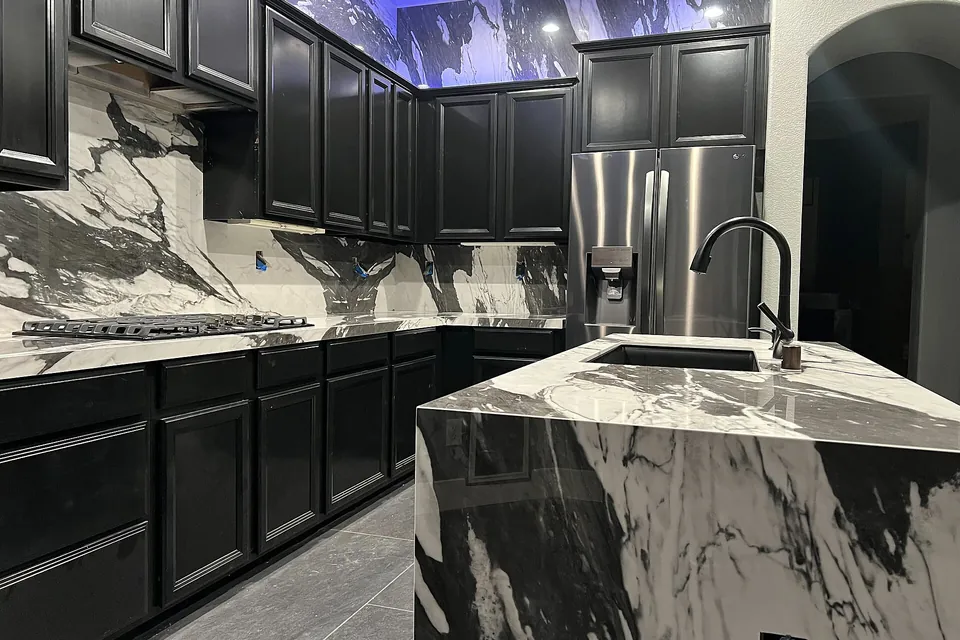
Long, uninterrupted countertops, backsplashes made from the same slab as the counter, and waterfall ends where the top runs down the side of an island create a monolithic look. Large-format porcelain panels, quartz, sintered stone, stainless steel, solid surface and concrete all appear in contemporary kitchens.
Technology that earns its place
Induction cooking
Induction cooktops heat the pan directly using a magnetic field. They are fast and precise, and the glass surface stays cooler than on radiant electric hobs, which makes it easier to clean. ENERGY STAR recognised residential induction cooking tops in its 2021 Emerging Technology Award, noting that they transfer heat to the pan more efficiently than conventional electric and gas cooktops. Induction also avoids burning gas indoors, which the US Environmental Protection Agency identifies as a source of nitrogen dioxide and other pollutants in homes. Cookware must be magnetic: cast iron and most stainless steel work, while aluminium, copper and glass usually do not.
Ventilation
Clean lines often lead designers to hide the range hood, with a slim built-in extractor, a ceiling cassette or a downdraft unit. Each compromises capture to some degree. Overhead hoods positioned close above the cooktop and at least as wide as it capture cooking fumes best. The ASHRAE 62.2 residential ventilation standard sets a minimum kitchen exhaust of 100 cubic feet per minute for intermittent fans, and the International Residential Code requires make-up air for hoods exhausting more than 400 cubic feet per minute. A quieter hood — look at the sone rating — is more likely to be switched on.
Lighting
Contemporary kitchens often use linear LED strips under wall cabinets, in shelves and in toe kicks, combined with recessed ceiling lights or a single sculptural pendant. Choose one colour temperature throughout and high colour rendering (a CRI of 90 or more) so that food and materials look natural.
Storage: the price of minimalism
- Tall pantry units with internal drawers hold dry goods and small appliances out of sight.
- Appliance garages — a cabinet on the counter with a lift-up or pocket door — keep the kettle, toaster and coffee machine plugged in but hidden.
- Deep drawers in all base units, with dividers and inserts planned for specific contents.
- Integrated bins for sorting recycling, compost and rubbish.
- Charging drawer or niche for phones and tablets, so cables do not trail across the counter.
Plan storage around a real inventory of what you own. A minimalist kitchen with too little storage ends up as cluttered as any other.
Materials and warmth
All-white, high-gloss contemporary kitchens can feel clinical. Warmth comes from texture and natural materials: wood veneers with a visible grain, matte finishes, a stone with gentle movement, textured tile, a timber floor. Mixing two or three materials — for example oak, a pale stone and a dark metal — keeps the room interesting while respecting the restraint of the style.
Practical considerations
- Fingerprints: high-gloss and dark matte surfaces show marks. Anti-fingerprint laminates and lacquers exist; ask for samples and test them.
- Durability of edges: thin countertops and sharp, square edges look crisp but chip more easily, especially on sintered stone and ceramic. A small bevel or eased edge improves durability.
- Composite wood products: cabinet boxes are usually made of particleboard or MDF. In the United States, composite wood products must comply with the EPA's formaldehyde emission standards under TSCA Title VI; look for a compliance label.
- Repairability: standard-sized cabinet boxes and hardware make it easier to replace a damaged front or hinge in years to come.
Trends worth thinking about
For the history behind the style, read the contemporary kitchen style and its roots; for cooktops and appliances, see kitchen cooktops and appliance trends, and for the wider picture, kitchen design trends.
Contemporary design changes faster than traditional styles. Recent directions include warmer wood tones instead of grey, darker or coloured cabinets, fluted or reeded textures, concealed "back kitchens" or sculleries that keep messy tasks out of the open-plan room, and the move towards all-electric kitchens. Trends are useful for ideas, but the features that age best are the functional ones: good storage, effective ventilation, durable surfaces and good light.
Sources
- ENERGY STAR, Emerging Technology Award 2021: residential induction cooking tops.
- US Environmental Protection Agency, "Nitrogen Dioxide's Impact on Indoor Air Quality".
- ASHRAE Standard 62.2, Ventilation and Acceptable Indoor Air Quality in Residential Buildings (local exhaust for kitchens).
- International Code Council, International Residential Code, section M1503.
- US Environmental Protection Agency, Formaldehyde Emission Standards for Composite Wood Products (TSCA Title VI).
Last reviewed: 6 November 2026.