Kitchen window treatments: blinds, shades and curtains that cope with steam and grease
The kitchen window is often the best-lit spot in the house, and usually the place where the sink sits. Dressing it is a small decision with more constraints than it looks: steam, grease and splashes attack fabrics and slats, a cooktop nearby adds heat, children reach for cords, and too much covering steals the daylight that makes a kitchen pleasant. This guide goes through the options and the practical questions that decide between them.
What makes kitchen windows different
- Moisture and grease. Cooking puts water vapour and fine grease droplets into the air. They settle on any surface near the window and bind dust into a sticky film. Whatever you choose should either wash easily or wipe clean.
- Splashes. A window above the sink is splashed daily. Fabric that hangs down to the sill will wick water and stain.
- Heat and flame. Fabric close to a cooktop is a fire risk. Keep curtains and blinds well clear of any burner, and never hang loose fabric where a draught could blow it towards a flame.
- Access. Reaching over a sink or counter to open a window or adjust a blind is awkward. Controls need to be within easy reach without leaning on a wet counter.
Do you need a covering at all?
Many kitchen windows look onto a garden or a quiet yard and need nothing. Leaving a window bare maximises daylight, which the US Department of Energy notes can cut the need for electric lighting during the day. Consider a covering only for a specific job: privacy from a street or neighbour, glare at a particular time of day, summer heat on a west or south window, or heat loss at night in winter.
The main options
Café curtains
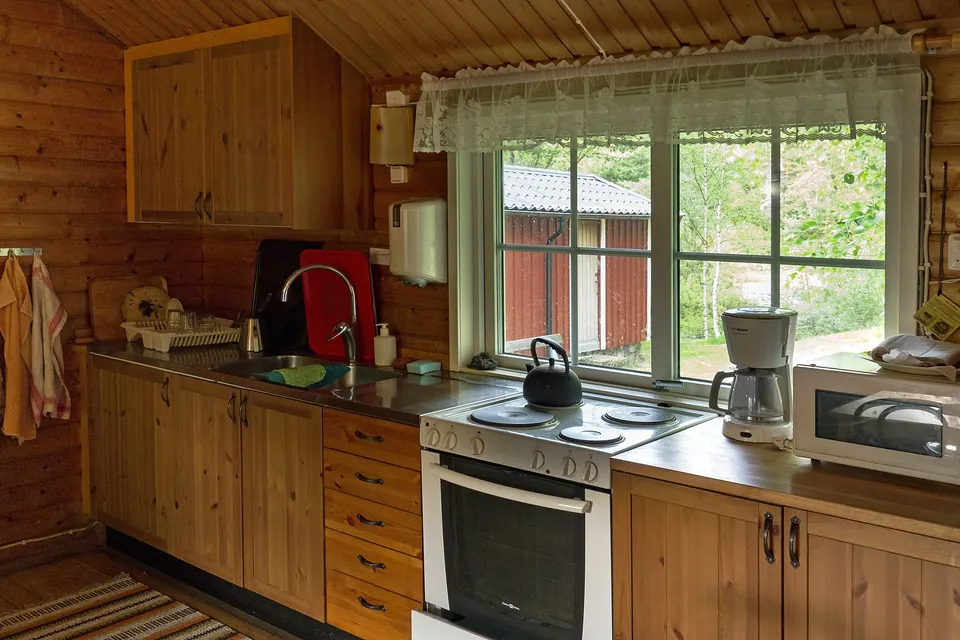
A short curtain hung across the lower half of the window, on a rod at mid-height, gives privacy at eye level while letting light in above. It is a traditional kitchen solution and suits country and cottage styles. Choose a washable cotton or linen, and keep the hem clear of the sill and the faucet.
Roman shades
Fabric shades that fold up in soft pleats add colour and pattern without the bulk of full curtains. In a kitchen, pick fabric that can be removed and washed, or a wipeable woven material, and mount the shade inside the window recess so it stays clear of the counter.
Roller shades
Simple, slim and easy to clean, roller shades come in light-filtering, room-darkening and solar-screen fabrics. Solar screens cut glare and heat while preserving a view outward during the day. Vinyl-coated and polyester fabrics tolerate humidity well.
Blinds
Horizontal blinds in aluminium, faux wood or PVC give fine control of light and privacy and resist moisture; real wood can warp in a steamy kitchen. Their weakness is cleaning: every slat collects grease, so plan to wipe them regularly or choose a wider slat that is quicker to clean.
Cellular shades
Honeycomb-shaped shades trap air in their cells and insulate the window. The Department of Energy's Energy Saver guidance identifies cellular shades among the coverings that can reduce heat loss through windows in winter. They are harder to clean than flat shades, so they suit windows away from the cooktop.
Shutters
Interior shutters with louvres are durable, wipeable and adjustable, and they suit traditional and farmhouse kitchens. They project into the room when open, so check that they clear the faucet and any wall cabinets.
Window films
Frosted, etched-look or patterned films applied to the glass provide privacy without any fabric at all. Nothing hangs near the sink, nothing collects grease, and the window still admits diffused light. Films suit bathrooms and kitchens alike and can be removed later, which makes them useful for renters.
Valances
A short fabric band across the top of the window softens it without covering the glass. It is decorative rather than functional, and it gathers grease like any fabric, so keep it washable.
Cord safety
Corded window coverings have caused strangulation deaths of young children for decades. In the United States, the Consumer Product Safety Commission warns parents to use cordless window coverings in homes with young children, and the industry standard ANSI/WCMA A100.1 has required stock (off-the-shelf) window coverings to be cordless or to have inaccessible cords since 2018. In 2022 the CPSC approved a federal safety standard for custom window coverings with operating cords. When you buy, look for cordless lift systems, motorised controls or wand tilts, and remove or tie up any loose cords on existing blinds.
Energy and comfort
Windows lose heat in winter and admit heat in summer. Shades and blinds help in both directions if they are used deliberately: closed on winter nights to keep warmth in, closed on summer afternoons on sun-facing windows to keep heat out, and open the rest of the time for daylight. Exterior shading — awnings, a pergola, or deciduous plants — blocks summer sun before it reaches the glass and is more effective than any interior covering for heat gain.
Choosing colour and pattern
A window treatment is one of the easiest places to bring colour or pattern into a kitchen, because it can be changed later without tools. Pick it after the fixed surfaces — countertop, tile, cabinets — and use it as the accent in the scheme. Light colours on the outside face of a shade reflect sun and look tidier from the street. Our colour basics guide explains how to build the palette around what you cannot change.
Practical checklist
- Decide what the covering must do: privacy, glare, heat, or nothing at all.
- Measure the recess at the top, middle and bottom, and check the depth for inside mounting.
- Check clearance from the faucet, the window handles and any nearby wall cabinets.
- Keep anything fabric well away from the cooktop.
- Choose washable or wipeable materials, and cordless operation.
- For evenings, plan how the window will work with your kitchen lighting: a dark, bare window reflects lamps like a mirror.
Sources
- US Consumer Product Safety Commission, window covering cord safety information and the 2022 safety standard for operating cords on custom window coverings.
- Window Covering Manufacturers Association, ANSI/WCMA A100.1-2018, American National Standard for Safety of Corded Window Covering Products.
- US Department of Energy, Energy Saver, "Energy Efficient Window Attachments" and daylighting guidance.
Last reviewed: 6 November 2026.