Decorative kitchen lighting: layering pendants, under-cabinet and accent light

Kitchen lighting has two jobs that pull in different directions. It must light the counters brightly and evenly enough to chop safely and read a recipe, and it must make the room pleasant to sit in at night. The answer, which lighting designers have used for decades, is to build light in layers, each with its own job and its own switch. Decorative fixtures — pendants, chandeliers, wall lights, glowing shelves — are the top layer. This guide explains how to choose and place them so that they are beautiful without leaving the cook in the shadow.
Three layers of light
- Ambient light fills the room so you can move around safely: recessed downlights, a ceiling fixture or indirect light bounced off the ceiling.
- Task light falls directly on work surfaces: under-cabinet strips over the counters, focused light over the sink and cooktop (often built into the range hood) and light over the island.
- Accent and decorative light creates atmosphere and draws the eye: pendants and chandeliers, lit glass cabinets, toe-kick strips, picture lights, a lamp on a counter.
The commonest mistake is to rely on one layer for everything — a single ceiling fixture that leaves the counters in your own shadow, or pendants expected to light the whole room. Put each layer on its own switch, ideally on dimmers, so you can choose bright working light or soft evening light.
Pendants
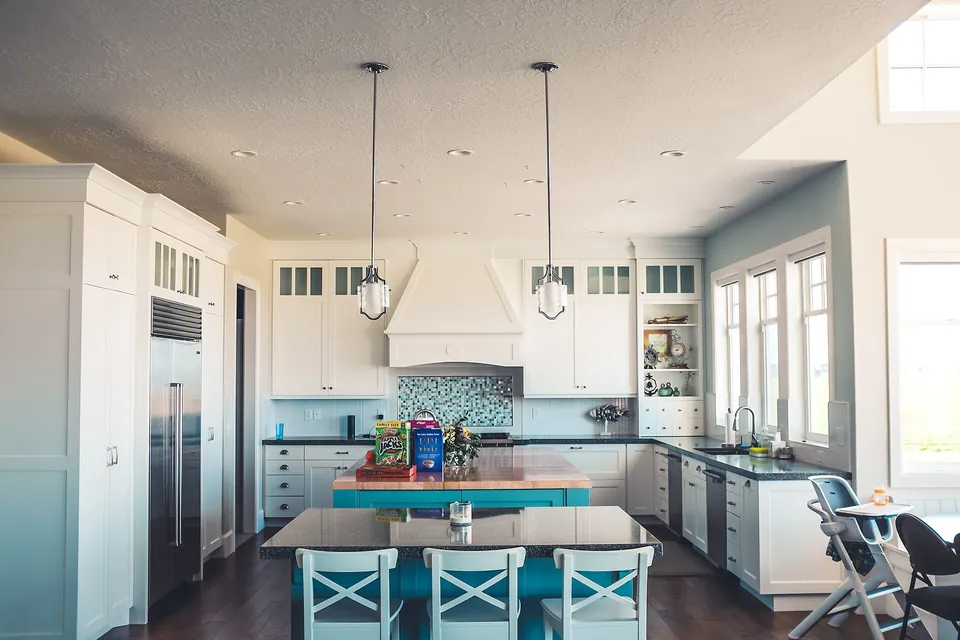
Pendants are the most popular decorative kitchen light, usually hung over an island, a peninsula or a table.
- Height: a common rule of thumb is to hang the bottom of the shade about 30 to 36 inches (75 to 90 cm) above the counter. Adjust for the height of the household and for sightlines across the room; over a dining table, slightly lower is usual.
- Number and spacing: two or three medium pendants suit most islands, spaced evenly with the outer ones set in from the ends. One long linear fixture is an alternative for a long island.
- Scale: pendants that are too small look lost over a large island; an old trick is to cut paper templates and tape them up before buying.
- Direction of light: opaque shades push light down onto the counter; glass and open shades spread it around the room and can glare at eye level. If the pendants are your only island lighting, choose ones that throw useful light downward.
Chandeliers and ceiling fixtures
A chandelier over a kitchen table brings a dining-room note to an open-plan space. Size it in proportion to the table — a common guideline is a diameter roughly half to two-thirds of the table's width — and keep it clear of anyone standing up. Remember that open-armed and crystal fixtures collect cooking grease and need regular cleaning; simpler shapes are easier to keep bright.
Under-cabinet lighting
Under-cabinet light is the most useful light in a kitchen and, done well, one of the most attractive. Mount LED strips or slim bars towards the front of the cabinet underside, so light falls on the counter and not into your eyes, and choose diffused strips so glossy counters and tile do not show a row of bright dots. Run them the full length of each counter run. Hard-wired systems with a hidden driver look tidiest; plug-in kits are an easy retrofit.
Accent ideas
- Glass-fronted cabinets lit from inside show off glassware and give a soft glow in the evening.
- Toe-kick lighting under base cabinets makes the cabinets appear to float and works as a gentle night light.
- Open shelves with a concealed strip under each shelf light the objects on the shelf below.
- Wall lights or sconces beside a window or over open shelving add warmth and break up the ceiling grid.
- Over-cabinet uplighting on top of wall cabinets bounces light off the ceiling, making a low room feel taller.
Choosing lamps: lumens, colour and colour rendering
With LED lighting, the old habit of choosing by watts no longer works. The US Federal Trade Commission's Lighting Facts label on lamp packaging shows brightness in lumens, estimated yearly energy cost, lifespan and colour appearance in kelvin. For a kitchen:
- Pick one colour temperature for all layers. Around 2700–3000 K feels warm and domestic; 3500–4000 K feels crisper. Mixing them looks patchy.
- Look for a colour rendering index (CRI) of 90 or more, so food, wood and paint look natural.
- Use dimmable lamps with compatible dimmers; mismatched combinations flicker or buzz.
- ENERGY STAR certified lamps and fixtures are tested for efficiency, lifespan and colour quality.
The US Department of Energy notes that LED lamps use far less energy and last far longer than incandescent lamps, which makes generous layered lighting inexpensive to run.
Safety and ratings
- Fixtures near the sink, over the cooktop or inside a range hood must be rated for the conditions — damp-location ratings near water, and heat-rated lamps in hoods. Check the listing on the fixture.
- Recessed lights in an insulated ceiling must be rated for contact with insulation (IC-rated) and, ideally, airtight.
- New circuits and hard-wired fixtures should be installed by a licensed electrician under local code.
Lighting and the rest of the room
Lighting interacts with every surface: glossy tile and polished stone reflect fixtures as hot spots, dark cabinets absorb light, and an uncovered window turns into a black mirror at night. Choose finishes and lighting together. Our guides to kitchen colour and window treatments cover the other half of the equation, and planning a kitchen island covers the electrical side of island pendants.
Sources
- US Department of Energy, Energy Saver, "Lighting Choices to Save You Money" and LED lighting guidance.
- US Federal Trade Commission, Lighting Facts label (16 CFR Part 305).
- ENERGY STAR, light bulbs and light fixtures specifications.
- National Fire Protection Association, NFPA 70, National Electrical Code (luminaires in damp locations and insulated ceilings).
Last reviewed: 6 November 2026.