Kitchen faucets: valves, spouts, sprays, finishes and water quality
The kitchen faucet is the fixture you touch most often, sometimes dozens of times a day, with wet, floury or greasy hands. A good one is easy to control with one hand, reaches every corner of the sink, fills tall pots without lifting them awkwardly, and keeps working smoothly for many years. This guide looks inside the faucet and through its options, so you can choose on function first and finish second. For the sink itself, see our guide to choosing a kitchen sink.
Inside the faucet: valve types
The valve controls flow and temperature. Its design largely determines how smooth the faucet feels and how long it lasts.
- Ceramic disc cartridges use two hard ceramic discs that slide over each other. They are durable, drip-resistant and standard in most modern single-lever faucets.
- Cartridge valves with rubber seals are common in two-handle and some single-handle faucets; the cartridge can usually be replaced without replacing the faucet.
- Ball valves, an older single-lever design, have more parts that can wear.
- Compression valves, found in older two-handle taps, close by squeezing a washer onto a seat; they are simple but need new washers from time to time.
Ask whether replacement cartridges are available and for how long. A faucet that can be rebuilt with a part is more economical, and less wasteful, than one that must be thrown away.
Handles
A single lever adjusts flow and temperature with one hand and can be nudged with a wrist when hands are dirty. Two handles give precise temperature control and suit traditional styles. Side-mounted levers need clearance behind the faucet — check that they will not hit the backsplash or a window sill. For people with limited grip, lever handles are much easier than knobs; the ADA Standards for Accessible Design call for controls operable with one hand, without tight grasping, pinching or twisting of the wrist.
Spouts: reach, height and swing
- Reach — the horizontal distance from the base to the outlet — should bring the stream near the centre of the bowl. Too short, and you rinse against the back of the sink; too long, and water lands near the front edge.
- Height — the clearance under the spout — decides whether a stockpot fits beneath it. High-arc spouts help, but in a shallow sink they splash more.
- Swing matters for double-bowl sinks and for faucets placed in a corner; check that the spout swings far enough without hitting a wall or window.
Sprays
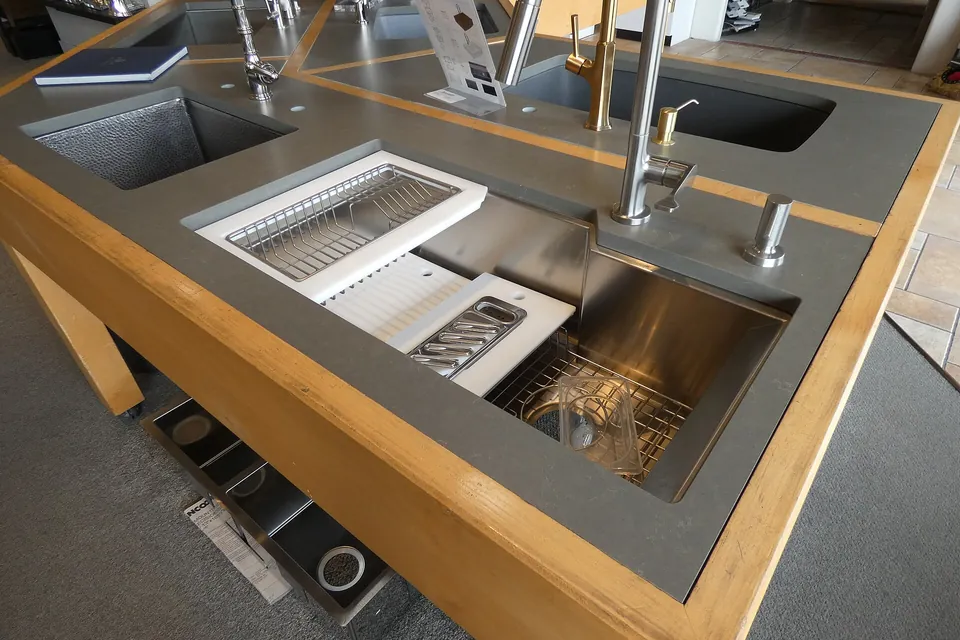
A pull-down spray head extends straight down from a high-arc spout and is ideal for rinsing the sink and vegetables. A pull-out spray on a lower spout pulls towards you, reaching pots set on the counter. A separate side spray keeps the main spout fixed and needs an extra hole. Good spray heads dock firmly with a magnet or a counterweight and offer at least a stream and a spray setting.
Touch, hands-free and other options
- Touch-activated faucets turn on with a tap on the spout or handle; motion-sensing ones respond to a hand beneath the outlet. Both are useful when hands are messy. They need batteries or a power supply under the sink, and a manual override for power cuts.
- Pot fillers are wall-mounted, folding faucets over the cooktop that fill heavy pots where they will be heated. They need a cold supply in the wall behind the range and, ideally, a shut-off valve accessible for repairs.
- Filtered or hot-water taps deliver filtered cold water or near-boiling water from a dedicated outlet. They require space under the sink for a filter cartridge or a small tank.
- Wall-mounted faucets keep the counter clear and suit apron sinks and traditional styles. They need supply lines in the wall, so plan them before the wall is closed.
Flow rates
US federal rules limit kitchen faucets to 2.2 gallons per minute at 60 psi. California's appliance efficiency regulations set a lower limit of 1.8 gallons per minute for kitchen faucets, while allowing a temporary boost to 2.2 for filling pots. A faucet's aerator mixes air into the stream, which keeps lower flow rates feeling generous. The EPA's WaterSense programme has practical advice on reducing water use at the tap.
Lead-free certification and water quality
Since 2014, the US Safe Drinking Water Act has required that pipes, fittings and fixtures delivering drinking water meet a "lead-free" definition limiting lead to a weighted average of 0.25 percent of wetted surfaces. Look for faucets certified to NSF/ANSI/CAN 61 and NSF/ANSI 372 by an accredited body. If you want a filter, check what it is certified to remove: NSF/ANSI 42 covers taste and odour such as chlorine, NSF/ANSI 53 covers health-related contaminants including lead for some products, and NSF/ANSI 58 applies to reverse-osmosis systems.
Finishes
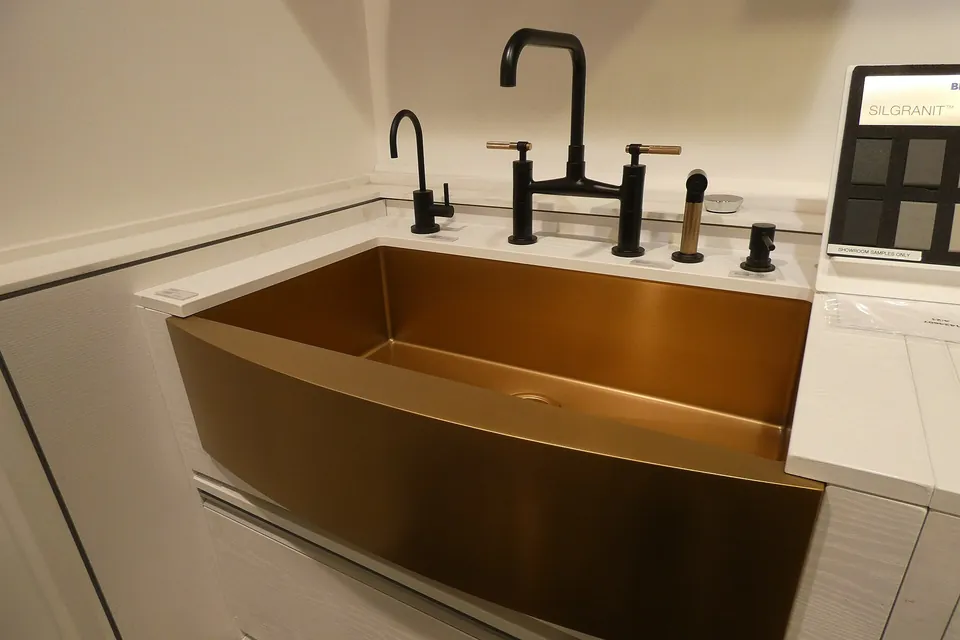
Polished chrome is durable and easy to clean but shows spots. Brushed or satin stainless and nickel hide water marks. Matte black and coloured finishes vary widely in durability; physical vapour deposition (PVD) finishes are generally the most resistant to scratches and cleaners. Unlacquered brass is designed to darken and develop a patina. Read the warranty on the finish, not just on the valve.
Installation and maintenance
- Count the holes in the sink or countertop and buy a faucet that fits them, or a deck plate to cover extra holes.
- Make sure shut-off valves under the sink work before the installation day.
- Clean the aerator every few months; mineral deposits reduce flow and cause spitting.
- Wipe the finish with mild soap and water; avoid abrasive pads and harsh descalers unless the manufacturer allows them.
Choosing a faucet for an apron-front sink? Our guide to types of farmhouse sinks covers wall-mounted and bridge faucets that suit them.
Sources
- US Code of Federal Regulations, 10 CFR 430.32 (federal faucet flow limits); California Energy Commission, Title 20 appliance efficiency regulations.
- Safe Drinking Water Act section 1417, as amended by the Reduction of Lead in Drinking Water Act (effective 2014).
- NSF International, NSF/ANSI/CAN 61, NSF/ANSI 372, 42, 53 and 58.
- US Department of Justice, 2010 ADA Standards for Accessible Design, section 309 (operable parts).
- US Environmental Protection Agency, WaterSense.
Last reviewed: 6 November 2026.